Agentic Enterprise: A Practical Roadmap to Get There (2026)
Picture a common starting point. A support assistant answers policy questions, a coding agent opens pull requests, and a finance team is piloting an agent that reconciles invoices. Each one works well enough on its own. The harder question arrives later. Dozens of agents start calling the same systems of record, acting for different users, and drawing on the same model budgets.
That question is what the term agentic enterprise is really about. It has less to do with how many agents you build. It has more to do with whether your architecture lets them act safely across the business. This guide covers what an agentic enterprise is and the minimum architecture it needs. It then lays out a three-stage roadmap and the failure patterns that keep programs stuck in pilot. The framework comes from WSO2's architecture work, but it is written so you can apply it to any stack.
What Is an Agentic Enterprise?
An agentic enterprise is an organization where AI agents operate as first-class actors alongside people, applications, APIs, and services. Agents take real actions across enterprise systems. They do so under policy and with an identity of their own. Every action is traceable and subject to the same operational discipline as any production workload.
The distinction from plain AI adoption is the ability to act. A chatbot that summarizes the HR leave policy is AI adoption. An agent that files a leave request on an employee's behalf, checks the manager's approval rules, and records who authorized what is an agentic capability. The goal is not more AI. The goal is an architecture where agents can work across enterprise capabilities while you keep auditability and operational control.
Why the Shift From App-Centric to Agentic Architecture Matters Now
Systems of record remain the source of truth for transactions, customers, and inventory. Around them, enterprises are adding what WSO2's leadership calls "systems of context", such as context graphs and knowledge bases. Agents act across both. Tools and policies become runtime dependencies, and generative AI models do the reasoning and planning.
In an app-centric world, you could standardize on interfaces (APIs), connectivity (integration), and guardrails (identity and observability). Those still matter, but they are no longer sufficient. Agents introduce new actors and new pathways to action. Their underlying models are probabilistic and usually work on unstructured data, so behavior can differ between two runs with the same input.
Timing matters too. Agents are no longer confined to engineering teams. Teams in operations, finance, and support are starting to use them to cut manual handoffs. When each team adopts agents on its own terms, the gains stay individual and the risks multiply. When agent tooling is built into the core stack as standard workflows and integrations, the gains become consistent and the controls become shared.
The blast radius depends on what the agent can do. An agent that only answers questions or drafts content has limited reach. An agent that calls tools, chains actions, and holds its own permissions is different, and that is where pre-agentic controls start to fall short.
Quality is the clearest example of the change:
- Traditional software is validated mainly through testing.
- Generative AI models also need evaluations that assess behavior where no single correct answer exists, often using another LLM as a judge.
- AI agents need both, plus attention to dynamic execution logic and its side effects.
Consider a refund agent. It can pass every unit, system, and regression test and still fail in production. The cause might be a lookup and a refund call chained in an order no test anticipated. Testing tells you the tools work. Evaluation and runtime observation tell you whether the agent uses them sensibly.
The Minimum Viable Architecture for an Agentic Enterprise
The seven capabilities below fall into three groups: access, trust, and operations. They are not a feature list. Treat them as a reference architecture and scope each one to the workloads you run. An agent limited to reading data may need little beyond identity, guardrails, and observability. An agent that changes records or moves money needs every capability in place before it reaches production. None of them depends on a particular vendor.
| Capability | What it controls | Question to ask of your current stack |
|---|---|---|
| Controlled ingress and egress | Inbound calls to your APIs and agents, and outbound calls from agents to models and external tools | Can you enforce and audit policy in both directions? |
| Tooling layer | How agents discover and reach internal and third-party tools, including MCP servers | Is there one governed catalog, or does each team wire its own tools? |
| Identity and policy | Which agent acted, and on whose behalf | Can you tell an agent's action apart from the human it represents? |
| Guardrails | Content and action limits for apps, models, MCP servers, and agents | Are guardrails enforced outside the prompt? |
| Observability | Traces across APIs, integrations, workflows, services, agents, and models | Can you reconstruct why an agent took a specific action? |
| Testing and evaluation | Functional correctness plus reasoning quality | Do agents face evaluations before release, not only tests? |
| Deployability | Where the stack runs | Can it run where your workloads and data residency rules require, without a rewrite? |
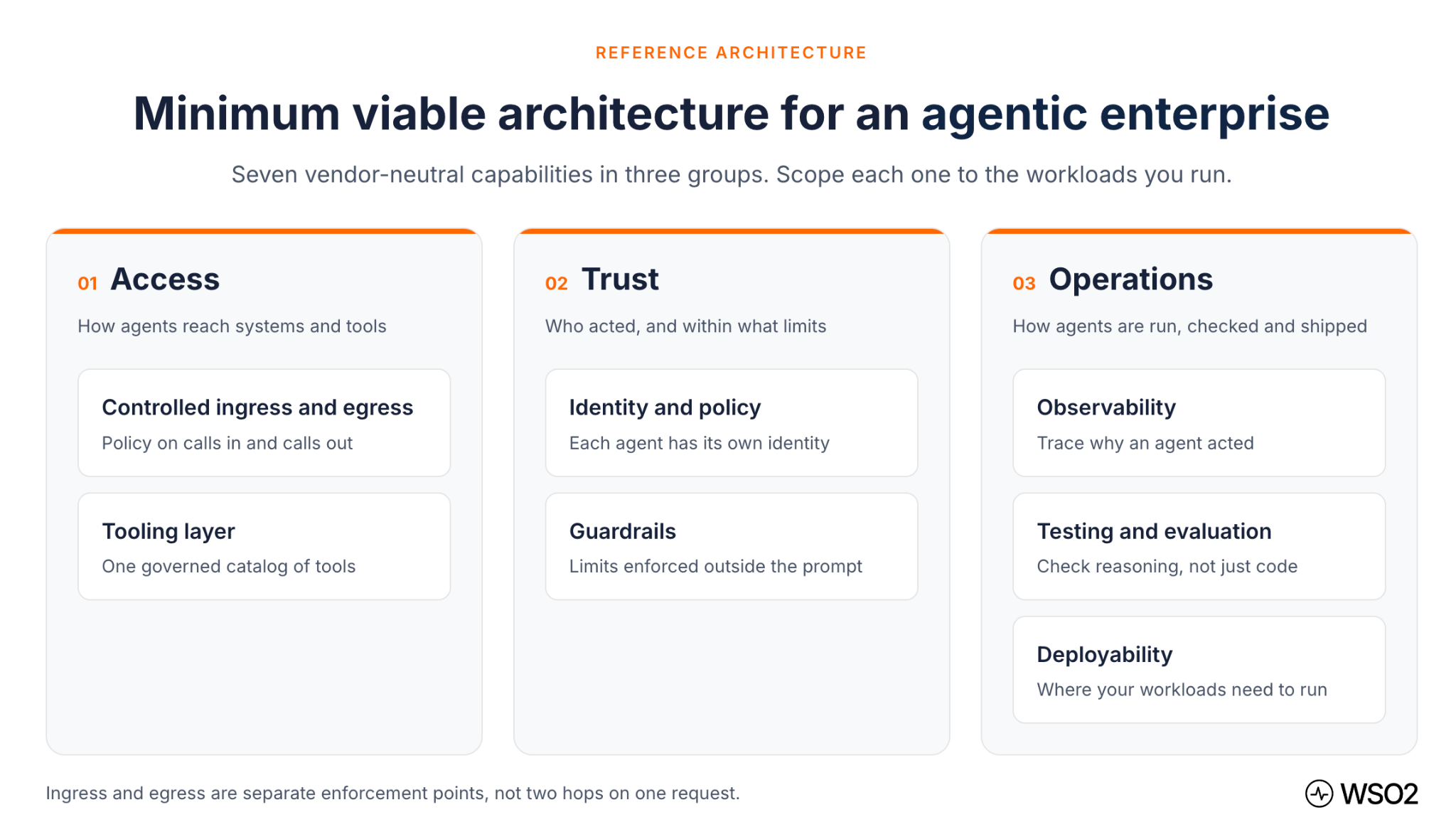
Ingress and egress are separate enforcement points, not two hops on one request. Scope each capability to the workloads you run.
Ingress and egress deserve a note because they are easy to draw wrong. Define both relative to your deployment boundary. Inbound traffic comes from users, applications, and external agents calling the APIs, agents, and MCP servers you expose. An API gateway governs inbound API calls, and an AI gateway can govern inbound agent and MCP tool requests. Outbound traffic goes from your agents to LLM providers and external MCP servers, and an AI gateway governs those calls. These are independent enforcement points, not two hops on one request. A single inbound request can trigger several outbound model calls, and each of those is governed on the egress side.
Identity needs the same precision. An agent acting for a customer should carry its own identity and a record of the delegation. Products like WSO2 Agent ID treat agents as first-class identities. Tokens then show whether an agent acted on its own or on a user's behalf.
For an example of a fabric that covers this list, look at the WSO2 Agentic Enterprise Fabric. It groups these capabilities into five platforms: Agent, API, Integration, Identity, and Engineering. Within it, the WSO2 API Platform manages API traffic and AI traffic from a single control plane. That includes LLM calls and MCP calls.
A 3-Stage Roadmap to Becoming an Agentic Enterprise
The architecture above says what you need. The roadmap below says how teams usually get there. Forrester's David Mooter puts the premise in the title of his analysis: "Agentic AI Runs On Integration, Not Data Lakes." He argues that an agent without integration can answer but cannot act. He also reports a split in priorities. Organizations with high readiness for agentic AI are prioritizing integration and change management. Those with low readiness are prioritizing model capabilities.
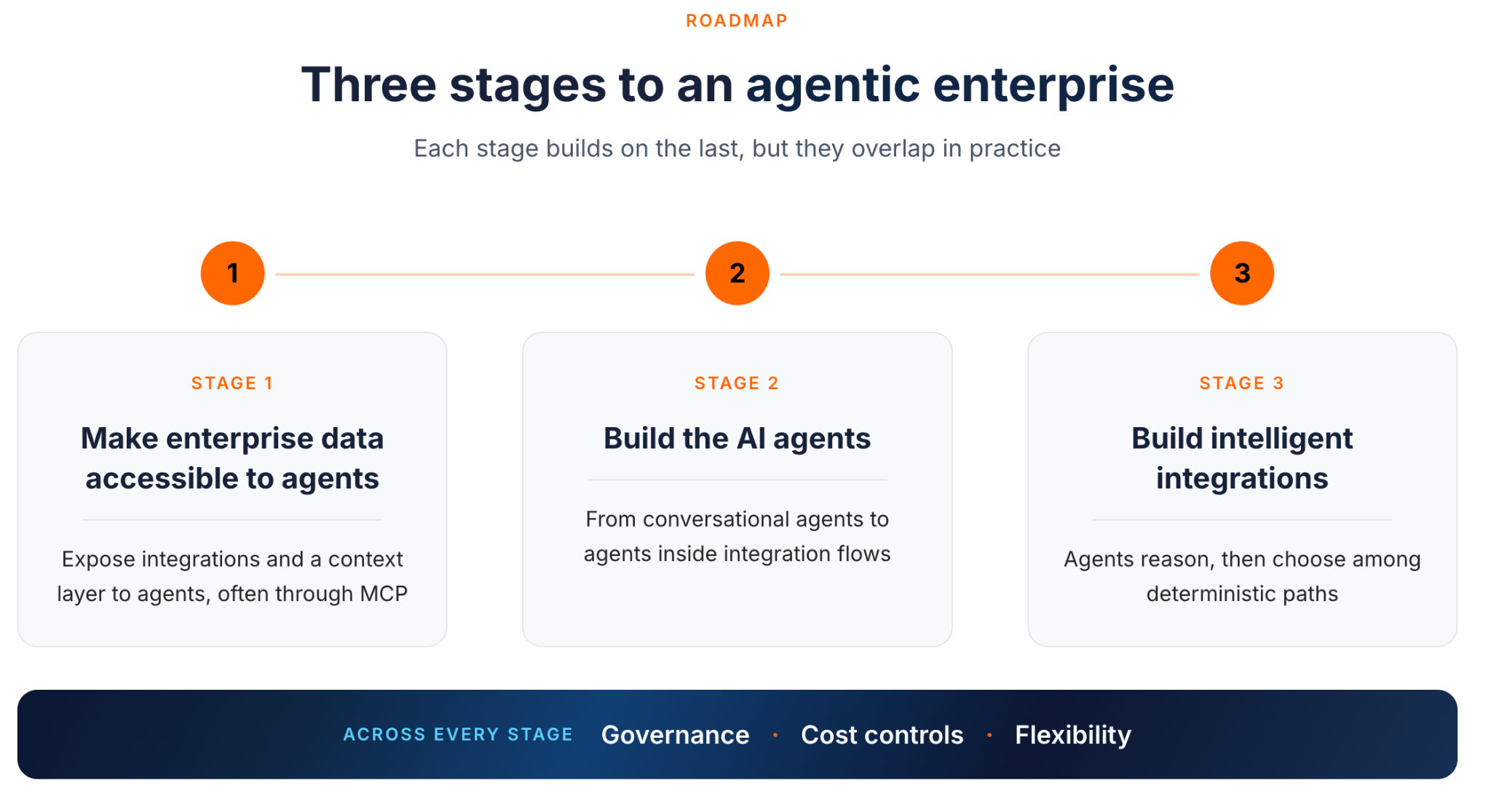
Each stage builds on the last, but they overlap in practice.
The stages build on each other, but they overlap in practice. Your integration and context layers will keep changing while you build agents on top of them.
Stage 1: Make enterprise data accessible to agents
Agents are only as useful as the context, data, and systems they can reach. Most enterprises already have an integration layer, but it was designed for system-to-system communication, not for agents. The next step is to expose those capabilities in a form agents consume well. REST, GraphQL, and events all work. An agent-oriented protocol such as the Model Context Protocol (MCP) is often a good fit. It gives many agent clients one standard way to discover and call tools. A native API integration can still be the better choice. That is often the case when your agent clients already support it well, or when it already meets your security and operational requirements. Let client compatibility and those requirements drive the choice.
Design those MCP tools around the tasks an agent performs rather than mirroring every existing endpoint one to one. A "check claim status" tool may need three backend calls. It is still one tool from the agent's point of view, and that keeps tool lists short and intent clear.
On top of the integration layer, build a context layer. It uses context graphs, data catalogs, and data pipelines. Together they combine operational data, enterprise metadata, past interactions, and real-time events into a form agents can use. A good context layer also records what changed, when it changed, and why. Agent decisions feed back into it and can inform later decisions.
A claims agent shows why history matters. Knowing a claim's current status is useful. Knowing that a similar claim from the same policyholder was escalated last quarter, and why, is what lets the agent make a defensible choice. The WSO2 Integration Platform is built around this stage, exposing business capabilities through open standards including MCP.
Stage 2: Build the AI agents
Once the base is in place, build agents and connect them to that exposed context through MCP. The range is wide. At one end are conversational agents for customer support, travel booking, or financial planning, often grounded in internal knowledge through retrieval-augmented generation. At the other end are agents that participate in broader integration flows and collaborate with other specialized agents, each owning one business function.
The interface does not set the risk. The actions an agent is permitted to take do. A conversational agent can book appointments, issue refunds, or change records, while an agent inside an integration flow may only read. Once an agent can write to systems of record, it needs its own identity, scoped permissions, and traces that connect its reasoning to the downstream calls it triggers.
Stage 3: Build intelligent integrations
Traditional integrations are deterministic in their control flow. Their steps and branching rules are fixed in advance, although results can still vary with system state, dependencies, and timing. Agents choose their next action at runtime. They reason over the context and options available to them, and they may not make the same choice twice.
An intelligent integration combines both in one flow. Insurance claims processing is a useful example:
- A customer starts a claim, which triggers the agent.
- The agent gathers details conversationally and reasons against historical and real-time context, including fraud checks and policy guidelines.
- The agent picks one of several deterministic paths: reject with comments, approve, or route to a human for final approval.
Fixed code paths alone do not guarantee safe effects. Deterministic code can execute an unauthorized or duplicate action just as consistently as a correct one. The agent's job is to choose among the paths. The agent may also reach a different decision on a similar claim later, because it has more context by then. That is expected behavior. The hard rules belong in the systems that carry out the action. They include authorization checks, transaction limits, required approvals, rate limits, and duplicate protection such as idempotency keys. Enforce them the same way whether a model or fixed code chose the path.
Three Things That Make or Break the Journey: Governance, Cost, and Flexibility
The three stages give you a direction. Governance, cost controls, and flexibility decide whether the program survives contact with production.
Governance
As agents become more autonomous, a misbehaving agent can do more damage. Governance sits in three places. It sits in the agent and integration logic itself. It sits in evaluation frameworks that check an agent's reasoning and decision steps before deployment. It also sits in human-in-the-loop approval for sensitive or high-risk actions at runtime. The OWASP Top 10 for Agentic Applications is a practical reference for the risks these controls should address.
Deciding where human approval applies is partly a design choice. Regulation, contracts, and separation-of-duties policies can require approval regardless of how well an agent performs. Within those limits, base it on the consequence of the action. Reversible, low-impact actions can usually run unattended. Actions that move money, change entitlements, or touch regulated data deserve a checkpoint. Evaluation results and production traces showing an agent handles an action reliably at scale are one input for reducing friction where approved policy permits it. They are not, on their own, the authority to remove a required control.
Cost controls
Unrestricted token consumption can drain an AI budget quickly and stall an initiative before it shows value. Cost control belongs on the outbound model path, because that is where every model call passes. The WSO2 AI Gateway is one example of this pattern already productized. According to its documentation, administrators set budget controls such as token-based rate limiting at the provider level. Developers then build per-application proxies that inherit those limits. The same gateway handles guardrails, semantic caching, and routing across multiple models and providers.
The second lever is how agents and integrations get built. Development is shifting toward AI-assisted, natural-language approaches where developers describe a requirement and AI generates the code. WSO2's integration tooling builds this on Ballerina, a language designed for integrations and agents. WSO2's position is that integration-specific abstractions lead to cleaner prompts, better generated code, and fewer regeneration cycles, which reduces token use during development.
Flexibility
The AI landscape is changing fast, and today's default stack will likely look different within a year. Two habits protect you. First, choose software that supports open standards such as MCP, REST, GraphQL, and gRPC. That keeps the option to switch vendors if costs, compliance needs, or features change. Second, prefer open source components where their licenses suit you. The WSO2 Integration Platform, for example, is released under the Apache 2.0 license. Source availability lets you self-host the software and inspect how your data is processed. Managed services, commercial support, and operating costs are separate decisions that source availability does not settle.
Agent frameworks are where lock-in tends to hide. Suppose tools are exposed through MCP and agent identities live in a standards-based identity provider. Moving an agent to a different framework then means rewriting the agent. It does not mean rewiring every tool connection and permission.
What Getting This Wrong Looks Like
Gartner predicts that over 40% of agentic AI projects will be canceled by the end of 2027. The reasons it cites are escalating costs, unclear business value, and inadequate risk controls. The failure patterns behind numbers like that tend to look familiar:
- Pilots that stall before production. The demo works, but nobody can answer the security review's questions about identity, audit, or data handling.
- Inconsistent controls across teams. One team routes model calls through a gateway, and another calls providers directly with a shared key.
- Brittle tool and data connections. Agents are wired point to point into systems, so every backend change breaks a prompt or a tool.
- Limited visibility when behavior goes wrong. An agent takes an unexpected action. No trace links the request, the model calls, and the tool calls.
- Lock-in decisions made too early. A tooling choice made for one pilot hard-codes the architecture for everyone who follows.
Each pattern maps back to a gap in the minimum viable architecture. That is the practical value of the checklist: it turns vague pilot friction into a specific missing capability.
Where to Start
Most enterprises are already somewhere on this journey, and the useful step is knowing where. Instead of a maturity score, look for the operational triggers that tell you which capability to add next:
- You use more than one model provider, or plan to. Centralize outbound model traffic so routing, failover, and policy live in one place.
- Nobody can say which team or agent drove last month's model spend. Add attribution and budgets at the egress point before scaling further.
- Prompts or tool calls can carry customer or regulated data. Enforce guardrails such as PII masking outside the prompt.
- Agents act on behalf of users. Give each agent its own identity and record the delegation.
- You are moving from one pilot to several production agents. Treat observability and evaluation as shared services rather than per-team projects.
Conclusion
Becoming an agentic enterprise is not a product purchase. It is an architectural commitment that you carry out in stages. The minimum viable architecture defines what has to exist before agents can act safely. The three-stage roadmap shows the order in which teams usually build it. Governance, cost controls, and flexibility keep the program from stalling between pilot and production.
None of this requires replacing what already works. Your systems of record, APIs, and integration layer remain the foundation. What changes is how you expose them, who is allowed to act on them, and how you observe and pay for that activity. Start with the gap your current triggers point to, close it, and then move to the next one.
The WSO2 agentic enterprise overview describes the platforms behind each of these capabilities. It is a useful reference to compare against what you run today.
Frequently Asked Questions
What is an agentic enterprise?
It is an organization that lets AI agents carry out work across its systems, not just answer questions. The agents operate with their own identities, within defined policies, and with every action logged for review.
What is an enterprise agentic platform?
It is the shared infrastructure that teams use to deploy and run agents in production. It typically covers agent identity, guardrails, observability, evaluation, and lifecycle management, so each team does not rebuild them.
What are agentic enterprise solutions?
They are the products and services that supply parts of the agentic architecture. Examples include AI gateways for model traffic, agent identity services, integration platforms that expose systems through MCP, and agent observability tools.
Do you need to replace existing systems to become an agentic enterprise?
No. Systems of record stay in place, and agents reach them through an integration layer. The work lies in exposing and governing access, not in replacing core systems.

