Building an API Governance Framework: Step by Step
Someone has asked you to "set up API governance." Your organization runs more APIs than anyone can list from memory. They are spread across several teams and more than one gateway. There is a style guide that a few people have read, and a security review that happens when somebody remembers to request one. The request sounds like it wants a policy document. What it needs is a working system.
This guide walks through building an API governance framework in the order that holds up in practice: stakeholders first, then standards, then enforcement, then metrics. Each step produces one artifact. Together, those artifacts form a template you can adapt to your own API estate.
The Four Building Blocks of a Governance Framework
An API governance framework has four building blocks, built in this order:
- Stakeholders and ownership: Who decides, who builds, who approves exceptions, and which team owns each API.
- Standards: The written rules for API design, contracts, security, and data handling.
- Enforcement: Automated checks that apply those rules at design time in CI and at runtime in the API gateway.
- Metrics: Measures that show whether APIs meet the standards and whether the program is improving.
The order is a dependency chain. Standards written before anyone owns them tend to stall in review, because nobody has the authority to settle disagreements. Enforcement built before standards exist ends up encoding one team's preferences as organization policy. Metrics collected without enforcement measure good intentions rather than API behavior.
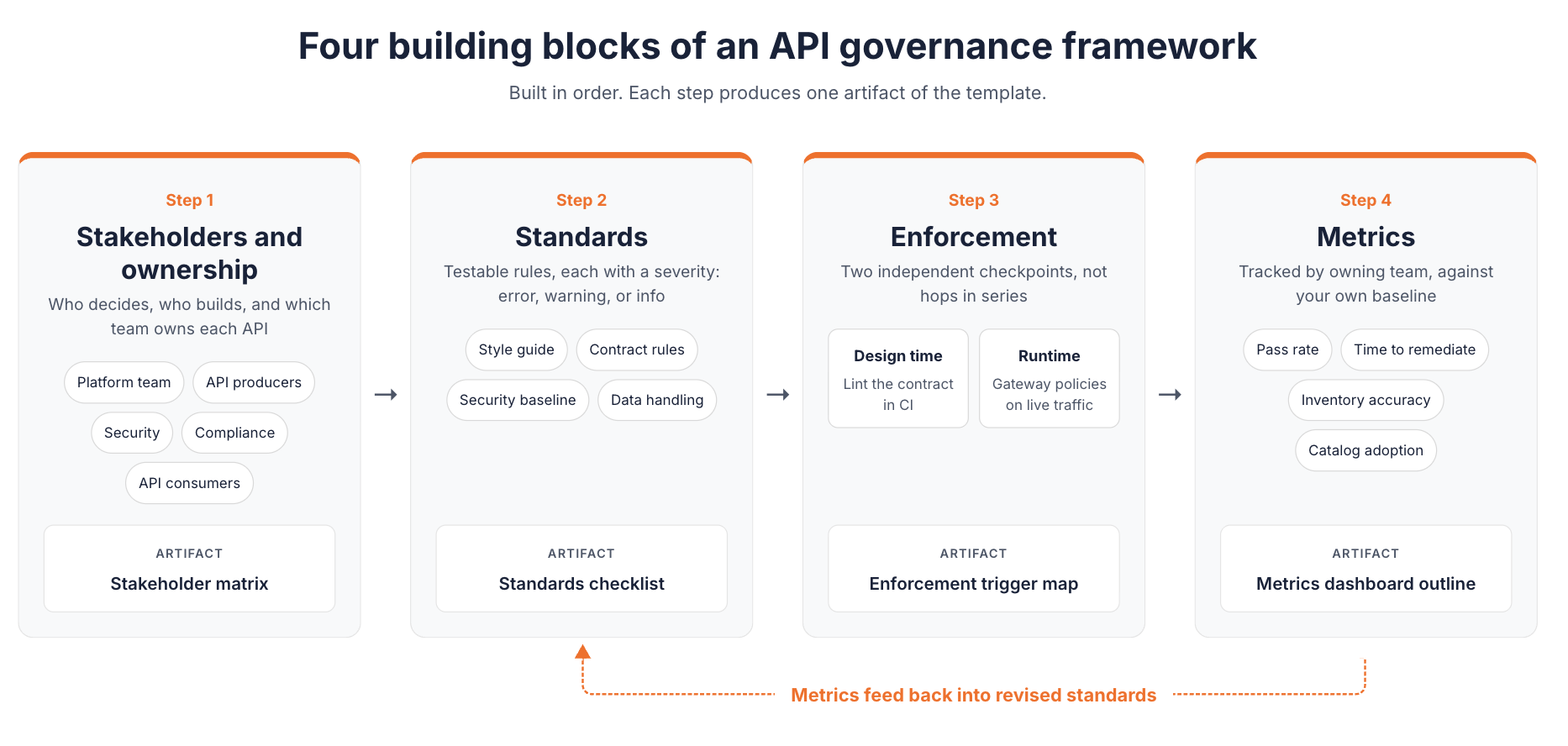
Four building blocks of an API governance framework, each producing one artifact of the template.
The figure shows the four steps of the framework. Enforcement has two independent checkpoints. Design-time checks run on the API contract in CI, and runtime checks run on live traffic at the gateway. Metrics then feed back into the standards, which is what turns a one-time rollout into a governance process that improves over time.
Step 1: Identify Stakeholders and Assign Ownership
API governance is an organizational problem before it is a tooling problem. Before writing a single rule, decide who needs a seat and what each group is accountable for.
- Platform team: Runs the shared tooling, including gateways, the developer portal, CI templates, and the governance rulesets. It owns the mechanics of enforcement, not the content of every rule.
- API producers: The teams that design and ship APIs. They own their contracts, fix violations in their APIs, and propose changes when a rule does not fit their domain.
- Security: Defines the security baseline, including authentication and authorization requirements and which findings count as release blockers.
- Compliance: Maps regulatory obligations to concrete data handling rules, such as which fields count as personal data and where that data may flow.
- API consumers: Internal and partner developers who call the APIs. Their complaints about inconsistent or hard-to-use APIs are often the earliest sign that a standard is missing or wrong.
Make API ownership explicit
Every API needs a named owning team recorded in its catalog metadata, not in someone's head. API ownership is what makes every later step possible. A violation with no owner tends to stay open, and an API version with no owner is rarely retired. Forgotten versions and undocumented hosts are a recognized risk category in their own right. The OWASP API Security Top 10 lists improper inventory management as API9:2023.
Choose a federated or centralized model
A centralized model keeps standards, tooling, and accountability with one team. That team does not have to review every change by hand. It can rely on automated checks in CI and at the gateway, and delegate day-to-day execution to API teams. The risk appears when centralization is implemented as manual review of every API, because review queues grow and teams start routing around them. A federated model sets a common floor centrally and lets domain teams own their APIs, with the option to add stricter rules for their area. For a first API governance program, a federated model with a thin central core is usually easier to sustain. The trade-offs between the two models are covered in more depth in our guide to API federation for multi-team API programs.
Write down decision rights while you are here. Record who can approve a new standard, who can grant an exception, and how long an exception lasts. Clear governance on these three questions heads off many of the arguments that stall programs later.
Step 2: Define Your Standards
Standards are the content of the framework. They fall into four groups, and each group has a natural owner among the Step 1 roles.
- Style guide: Naming conventions, versioning, pagination, error formats, and status code usage. This is where consistent API design starts.
- Contract rules: What every API definition must include. Use the OpenAPI Specification as the contract format for REST APIs, and require the fields reviewers otherwise check by hand. Common examples are an operation ID on every operation, documented error responses, and declared security schemes.
- Security baseline: Authentication and authorization requirements, transport security, and input validation expectations. The OWASP API Security Top 10 gives security teams a shared reference for which risks the baseline should address.
- Data handling standards: Which fields are classified as sensitive, rules against personal data in URLs and query strings, and what may appear in logs.
Write every rule so it can be tested
A rule that cannot be checked will not be enforced. "Use clear resource names" leaves every reviewer to interpret it differently. "Path segments use lowercase kebab-case" can be checked by a linter in seconds. Whether each segment is a plural noun is harder to automate. Treat plural naming as a review convention, or check it against a maintained list of approved resource names. Rewrite each standard until a machine or a reviewer can return a clear pass or fail.
Some rules will stay human judgment calls, and that is fine. "Does this API duplicate an existing one?" needs a person who knows the API estate. Mark those rules as review checks so they land in a design review gate instead of a linter.
Assign a severity to every rule
Give each rule a severity level: error, warning, or info. Severity tells teams what blocks a release and what only needs attention. It also maps directly to how most linting tools and governance platforms report findings, so the decision you make here carries through to enforcement.
Step 3: Build Enforcement Into the Pipeline
Standards change API quality only when something checks them. Effective API governance enforces rules at two independent points in the API lifecycle.
Design-time governance checks the API contract before it ships. The usual place is CI, where a linter runs against the OpenAPI or AsyncAPI definition on every pull request. The open-source Spectral linter is a common choice, and it uses YAML rulesets that encode your standards from Step 2. Configure the job to fail on error-severity findings, and branch protection can then block the merge. Our guide to building a CI/CD pipeline for APIs covers where this stage fits alongside testing and deployment.
Runtime governance checks live traffic. Runtime policy enforcement happens in the API gateway, which applies authentication and authorization, rate limiting, and request validation to each call. These policies catch what a contract cannot show, such as a client that sends an expired token or exceeds its quota.
The two checkpoints are independent. A contract lint does not sit in the request path, and the gateway does not need CI to run. Map each check to where it runs:
| Check | Where it runs | What happens on failure |
|---|---|---|
| Style and contract rules | CI, on every change to the API definition | The CI job fails, and branch protection can block the merge |
| Security baseline in the contract | CI and platform governance policy | CI fails, and the platform flags the finding for the owning team |
| Authentication and authorization on calls | API gateway request flow | The gateway rejects the request |
| Rate limiting | API gateway request flow | The gateway throttles the client |
| Changes to an API definition | Platform governance policy, re-evaluated when the API proxy is updated | Promotion waits for a reviewer |
| Runtime drift from the approved contract | Contract tests and configuration comparisons against deployed APIs | The test run fails and the owning team investigates |
Traffic direction matters when you map runtime checks. Inbound calls from clients to your APIs pass through the API gateway. Outbound calls from your applications to third-party services, including LLM providers, need their own egress policies. These are separate paths with separate policy sets. They do not chain into one sequence of hops.
What Step 3 looks like on WSO2 API Platform
WSO2 API Platform includes a built-in governance framework that maps onto this step. Rulesets are Spectral YAML rule definitions that validate an API's definition, metadata, and documentation for REST and async APIs. The console includes ready-made rulesets such as WSO2 API Design Guidelines, WSO2 Style Guidelines, and an OWASP Top 10 ruleset. You can also upload governance standards written in natural language as PDF documents, which the AI Compliance Analysis feature uses to evaluate APIs.
Policies attach rulesets to the organization's API proxies and define what happens at each severity level. Policies are evaluated when API proxies are updated. The documented violation action at present is Notify, so findings surface to the owning team rather than stopping the update. In practice, pair platform policies with a failing CI lint for the rules you treat as hard blockers. The platform policy then re-evaluates API definitions across the whole estate whenever they change, and CI acts as the merge gate. Policy results describe the submitted definition, not the running backend. A backend can change without any proxy update, so detect runtime drift separately by comparing deployed configurations and tested responses with the approved contract.
Runtime governance sits in the same platform. Gateway policies from the Policy Hub, such as JWT and API key authentication, handle runtime checks on API traffic. Environment promotion can also require approval from designated reviewers before an API proxy reaches production. For outbound AI traffic, the platform's AI Gateway applies its own policies, such as guardrails and token-based rate limiting. All of these are managed from one control plane, so APIs and AI traffic are governed from the same place rather than through separate tools.
Step 4: Define and Track Governance Metrics
Metrics are how you prove the framework works and find where it does not. Start with four measures, and track each one by owning team. An organization-wide average hides where the problems sit.
- Governance pass rate: The share of in-scope APIs with no error-severity findings.
- Time to remediate: How long a violation stays open from first detection to resolution. If this rises, either a standard is out of step with how teams build, or owners do not have time to fix findings.
- Inventory accuracy: How closely the API catalog matches what is actually running. Compare catalog entries against the APIs that receive traffic at your gateways. A gap in either direction is a finding. Running APIs missing from the catalog are shadow APIs, and catalog entries with no traffic are retirement candidates.
- Catalog adoption: The share of new integrations that start from the developer portal or catalog rather than a direct request to the producing team. This measures API discovery, and it shows whether governance is making APIs easier to find and reuse.
Two supporting signals are worth adding once the core four are stable. The first is the number and age of open exceptions, because exceptions that never expire quietly become the real standard. The second is open error findings in security rulesets, which gives security teams a direct view of the API security posture.
Set targets from your own baseline rather than from published industry figures. Your first round of data shows where each team starts, and improvement against that baseline is the number that matters. Traffic and usage analytics from your gateways complement these governance measures.
Putting It Together: A Governance Framework Template
The four steps produce four artifacts. Kept together and kept current, they are your API governance framework template.
| Artifact | What it contains | Built in | Revisit when |
|---|---|---|---|
| Stakeholder matrix | Governance decisions as rows, roles as columns, and "decides", "consulted", or "informed" in each cell | Step 1 | A team is added or reorganized |
| Standards checklist | One row per rule with an ID, the testable statement, category, severity, check type (automated or review), owner, and rationale | Step 2 | A rule generates repeated exception requests |
| Enforcement trigger map | The Step 3 check table, extended with the tool and owning team for each check | Step 3 | A new gateway, pipeline, or API type is introduced |
| Metrics dashboard outline | One panel per Step 4 measure, sliced by owning team and severity, with a trend line and the open exception list | Step 4 | A metric stops changing decisions |
The stakeholder matrix works best when its rows are concrete decisions. Good rows include "approve a new standard", "grant an exception", "change a rule's severity", and "retire an API version". Abstract rows such as "governance oversight" give nobody a clear answer.
The standards checklist is the artifact you will edit most. Keep the rationale column filled in. When someone challenges a rule a year from now, the rationale is what lets the governance strategy evolve without restarting the debate from scratch.
The template does not depend on a specific platform. If you want to see steps 2 to 4 running in one place, WSO2 API Governance capabilities work as a reference implementation. Rulesets and governance documents hold the standards checklist. Governance policies and gateway policies carry out the enforcement trigger map. The compliance dashboard reports policy and ruleset adherence at the organization, project, and component levels, which supports the governance pass rate. Time to remediate, inventory accuracy, and catalog adoption need separate instrumentation. Typical data sources are issue tracker timestamps, gateway traffic logs, and developer portal usage records. AI compliance analysis runs on request, and its findings are AI-generated. Treat them as input for reviewers rather than an independent compliance decision.
Common Mistakes When Building a Framework
Skipping stakeholder buy-in
A framework announced by the platform team without producer or security involvement gets treated as someone else's project. Teams comply with the letter of the rules and route around their intent. Bring each Step 1 group into the drafting of the standards it will be held to.
Over-centralizing
A single review board for every API change feels safe and scales poorly. Once queue times grow, teams start shipping outside the process. Centralize the floor and the tooling, and leave domain-specific rules to the teams that own those APIs.
Defining standards without enforcement
A style guide in a wiki is documentation, not governance. If a rule matters enough to write down, it needs a check in CI, at the gateway, or in a named review step.
Turning every rule into a blocker on day one
Introducing a large ruleset at error severity across an existing estate creates a wall of failures. Teams quickly learn to ignore them. Start new rules at warning severity, give owners time to clear the backlog, and then promote the rules that matter to error.
Measuring nothing
Without metrics, nobody can tell whether the program improved API quality or only added process. Even a basic pass rate and time-to-remediate report, tracked by team, gives you something to act on.
Conclusion
An API governance framework works when four parts run together, built in order. You need owners who can make decisions and standards written as testable rules. You also need enforcement at both design time and runtime, and metrics that show where the rules hold and where they need revising.
You should start small. Name an owner for every API, choose the few rules that matter most, and run them as warnings in CI before promoting them to errors. Measure your starting baseline, and let those results decide which standard to tighten next.
To see the standards, enforcement, and metrics layers working together, explore WSO2 API Platform's governance capabilities as a reference implementation.
Frequently Asked Questions
What is an API governance framework?
An API governance framework is the set of roles, standards, automated checks, and metrics an organization uses to keep its APIs consistent, secure, and compliant.
What is the difference between design-time and runtime API governance?
Design-time governance checks an API's contract before release, usually by linting the OpenAPI or AsyncAPI definition in CI. Runtime governance applies policies to live traffic at the API gateway, such as authentication, authorization, and rate limiting. Most programs need both.
Who should own API governance?
A platform team usually owns the tooling and the shared baseline. Each API's owning team is accountable for its own compliance. Security and compliance teams own the rules in their areas and approve exceptions to them.
How do you know if API governance is working?
Track the share of APIs passing governance checks and how long violations take to fix. Add how accurately the catalog reflects what is running and how often teams find APIs through it. Compare each measure against your own starting baseline.
Is there an API governance framework template or PDF?
A usable template has four parts: a stakeholder matrix, a standards checklist, an enforcement trigger map, and a metrics dashboard outline. All four fit in one shared document that you can export to PDF for review and sign-off.

