Verifiable Credentials
Verifiable Credentials (VCs) are tamper-evident digital credentials that allow anyone to verify information about a subject (such as a user) without contacting the credential issuer directly. WSO2 Identity Platform supports issuing verifiable credentials to digital wallets using the OpenID for Verifiable Credential Issuance (OID4VCI) standard, and can also act as a verifier that authenticates or registers users based on credentials they present using the OpenID for Verifiable Presentations (OID4VP) standard.
Why verifiable credentials?
Traditional identity verification often requires real-time communication with the credential issuer or centralized databases. Verifiable credentials solve this by enabling a decentralized trust model:
- Decentralized trust — Verifiers can check credential authenticity using cryptographic proofs without contacting the issuer.
- User control — Holders store credentials in their own digital wallets and choose when and with whom to share them.
- Selective disclosure — With formats like Selective Disclosure JSON Web Token, holders can reveal only specific claims (e.g., prove their age without disclosing their full date of birth).
- Standards-based — Built on open standards (OID4VCI, W3C Verifiable Credentials), ensuring interoperability across different systems and wallets.
Common use cases
Verifiable credentials enable a wide range of real-world identity and trust scenarios:
-
Authentication — Users can authenticate to applications by presenting a verifiable credential from their wallet instead of using passwords or traditional identity providers. The verifier validates the cryptographic proof without contacting the issuer.
-
Identity verification — Organizations can issue credentials representing verified identity attributes (e.g., government ID, employee status, age verification) that users can present on demand—eliminating repeated identity checks across different services.
-
Digital signatures — Credentials can carry cryptographically signed claims that act as tamper-proof attestations, enabling use cases such as signing documents, authorizing transactions, or attesting to qualifications.
How it works
The verifiable credentials model involves three parties:
- Issuer — The organization that creates and signs the credential. WSO2 Identity Platform acts as the issuer.
- Holder — The user who receives the credential in their digital wallet and presents it when needed.
- Verifier — The party that checks the credential's authenticity and reads its claims.
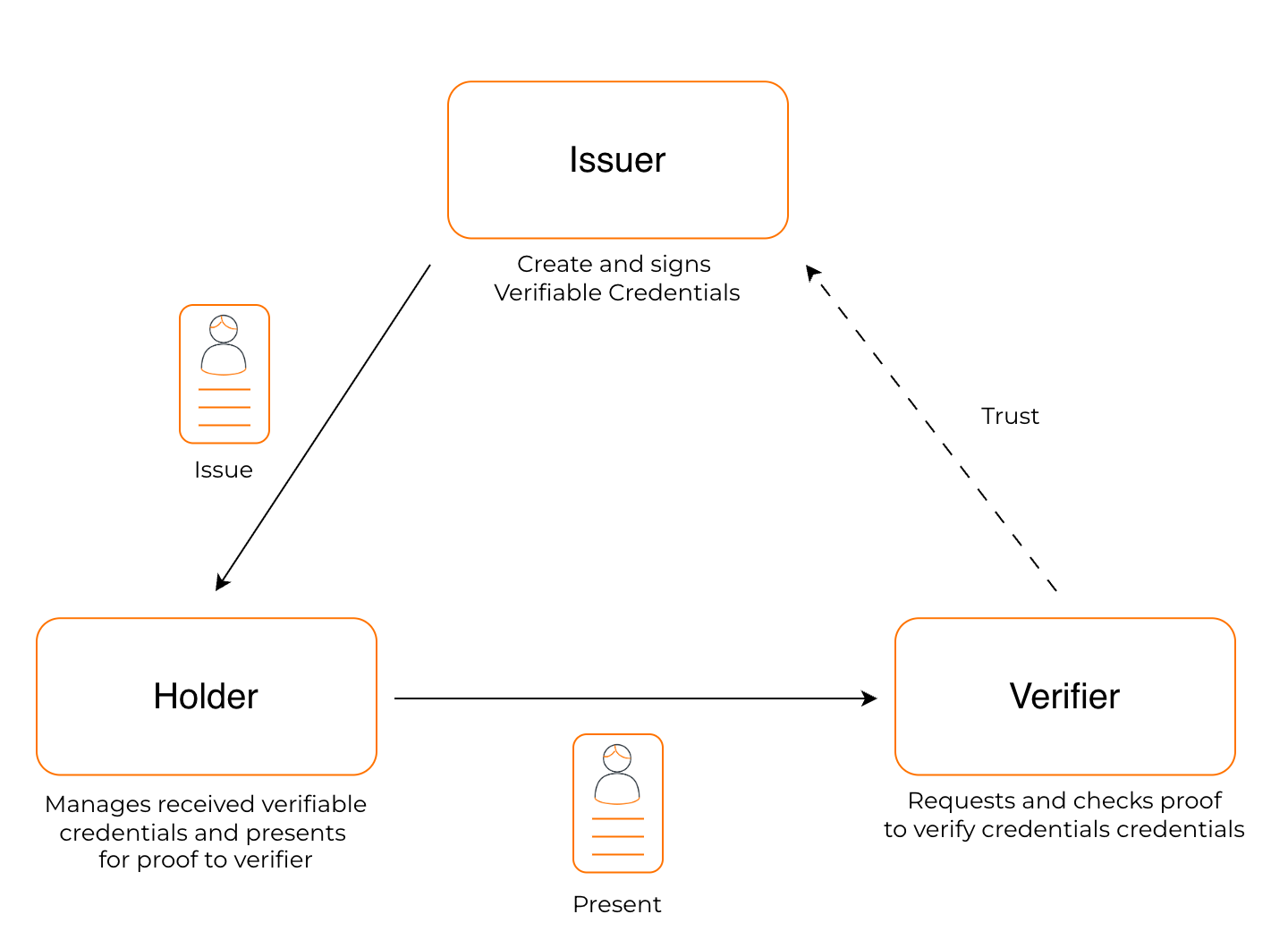
WSO2 Identity Platform uses the OID4VCI protocol to issue credentials to any conformant digital wallet. The wallet receives a credential offer, the user authenticates, and WSO2 Identity Platform delivers a cryptographically signed credential. WSO2 Identity Platform also uses the OID4VP protocol to request and verify credentials from a digital wallet, allowing users to authenticate or register using credentials they already hold.
What you can do
Use the guides in this section to issue verifiable credentials from WSO2 Identity Platform to standards-compliant digital wallets, or to verify credentials presented by one.
-
Issue Verifiable Credentials to a Digital Wallet — Step-by-step guide to configure WSO2 Identity Platform and issue a verifiable credential to any OID4VCI-compatible digital wallet.
-
OpenID for verifiable credential issuance (OID4VCI) — Understand how OID4VCI works, the supported credential formats, key endpoints, and cryptographic binding.
-
Verify credentials from a Digital Wallet — Step-by-step guide to configure WSO2 Identity Platform as a verifier and authenticate or register users with credentials presented from an OID4VP-compatible digital wallet that supports the
dc+sd-jwtcredential format.