OpenID for Verifiable Credential Issuance (OID4VCI)
WSO2 Identity Platform supports issuing verifiable credentials to digital wallets using the OID4VCI protocol. This page explains the key concepts, supported flows, credential formats, and endpoints.
Info
OID4VCI is defined by the OpenID for Verifiable Credential Issuance specification. WSO2 Identity Platform's implementation follows this specification to ensure interoperability with any conformant digital wallet.
What are verifiable credentials?
A verifiable credential (VC) is a tamper-evident digital document that represents claims about a subject (for example, a user's name, job title, or degree). VCs are cryptographically signed by the issuer, held by the holder in a digital wallet, and presented to a verifier who can check authenticity without contacting the issuer.
This three-party trust model — issuer, holder, verifier — is the foundation of decentralized identity.
What is OID4VCI?
OpenID for Verifiable Credential Issuance (OID4VCI) is a protocol built on OAuth 2.0 and OpenID Connect. It standardizes how a credential issuer delivers verifiable credentials to a digital wallet.
WSO2 Identity Platform acts as the credential issuer. It exposes the necessary endpoints to allow a conformant digital wallet to:
- Discover the issuer's capabilities via a well-known metadata endpoint.
- Get authorization (interactively or via a pre-authorized code).
- Request and receive a signed verifiable credential.
Credential issuance flow
WSO2 Identity Platform supports the authorization code flow for credential issuance. In this flow, the user authenticates interactively before receiving a credential.
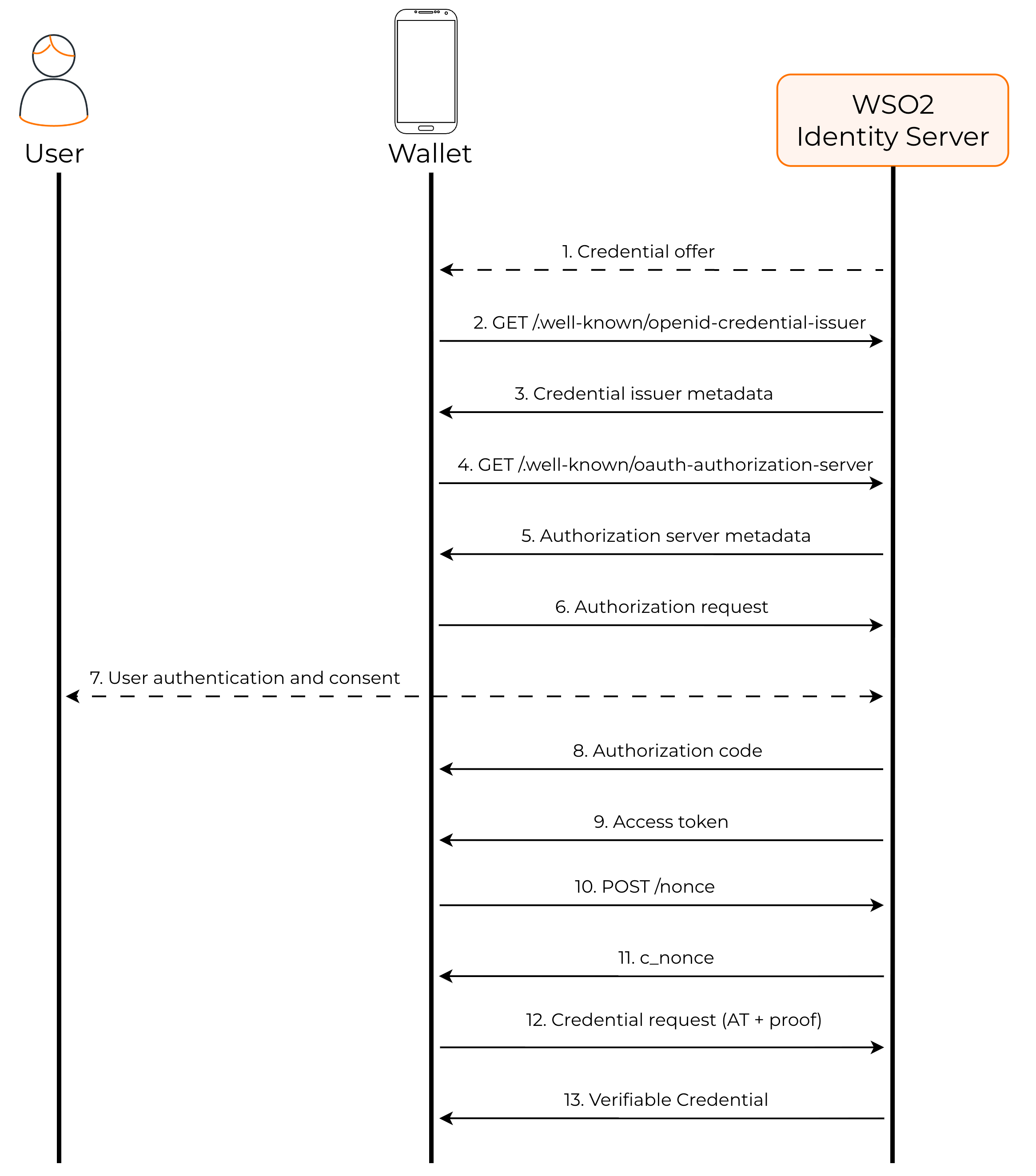
- Credential offer — WSO2 Identity Platform generates a credential offer delivered as a QR code or deep link. The wallet scans or follows it to begin the issuance flow.
- GET /.well-known/openid-credential-issuer — The wallet fetches credential issuer metadata (typically from
/oid4vci/.well-known/openid-credential-issuer) to discover supported credentials and endpoint URLs. - Credential issuer metadata — WSO2 Identity Platform returns the issuer metadata, including supported credential configurations and endpoint locations.
- GET /.well-known/oauth-authorization-server — The wallet fetches authorization server metadata to discover OAuth 2.0 endpoints such as authorization and token endpoints.
- Authorization server metadata — WSO2 Identity Platform returns the authorization server metadata.
-
Authorization request — The wallet sends an authorization request to WSO2 Identity Platform including
scopespecifying the verifiable credential being requested.Note
Some wallets use the Pushed Authorization Request (PAR) endpoint (
POST /oauth2/par) to send the authorization request directly to the server before redirecting the user. This improves security by keeping request parameters out of the browser URL. If the wallet supports PAR, it will use therequest_urireturned by the PAR endpoint in the authorization redirect. -
User authentication and consent — WSO2 Identity Platform prompts the user to sign in and grant consent to share the requested attributes with the wallet.
- Authorization code — WSO2 Identity Platform issues an authorization code and redirects back to the wallet's callback URL.
- Access token — The wallet exchanges the authorization code at the token endpoint, and WSO2 Identity Platform returns an access token bound to the authorized credential request.
- POST /nonce — The wallet sends
POST /oid4vci/nonceto get a fresh server-generated nonce (c_nonce) used to prevent replay attacks. - c_nonce — WSO2 Identity Platform returns the
c_noncevalue. - Credential request (AT + proof) — The wallet sends a credential request to the credential endpoint, including the Bearer access token and a JWT proof signed with
c_nonceto prove possession of the private key. - Verifiable Credential — WSO2 Identity Platform validates the access token and proof, then returns the signed verifiable credential (for example, an SD-JWT VC) to the wallet.
Supported credential formats
WSO2 Identity Platform supports the following credential formats:
| Format | Description |
|---|---|
dc+sd-jwt |
SD-JWT VC — Selective Disclosure JWT-based verifiable credential. Allows the holder to selectively disclose individual claims to a verifier without revealing the full credential. |
jwt_vc_json |
JWT VC JSON — Standard JWT-based verifiable credential encoded as a JSON object. All claims are included in the token and signed by the issuer. |
Key endpoints
WSO2 Identity Platform exposes the following OID4VCI endpoints:
| Endpoint | Path | Purpose |
|---|---|---|
| Credential issuer metadata | /oid4vci/.well-known/openid-credential-issuer |
Advertises the issuer's capabilities, supported credential configurations, and endpoint URLs. |
| Credential offer | /oid4vci/credential-offer?credential_offer_uri=... |
Delivers a credential offer to the wallet via a URI reference. |
| Nonce | /oid4vci/nonce |
Issues a fresh nonce used to bind the wallet's proof of possession. |
| Credential | /oid4vci/credential |
Issues the signed verifiable credential after validating the access token and proof. |
Sample credential issuer metadata response
The following is an example response from the /oid4vci/.well-known/openid-credential-issuer endpoint. Wallets use this to discover what credentials the issuer supports and how to request them.
{
  "credential_issuer": "https://localhost:9443/oid4vci",
  "credential_endpoint": "https://localhost:9443/oid4vci/credential",
  "nonce_endpoint": "https://localhost:9443/oid4vci/nonce",
  "authorization_servers": [
    "https://localhost:9443/oauth2/token"
  ],
  "credential_configurations_supported": {
    "work_id": {
      "id": "work_id",
      "format": "dc+sd-jwt",
      "scope": "work_id",
      "vct": "work_id",
      "credential_signing_alg_values_supported": [
        "RS256"
      ],
      "cryptographic_binding_methods_supported": [
        "jwk"
      ],
      "proof_types_supported": {
        "jwt": {
          "proof_signing_alg_values_supported": [
            "RS256", "RS384", "RS512",
            "PS256", "PS384", "PS512",
            "ES256", "ES384", "ES512"
          ]
        }
      },
      "credential_metadata": {
        "display": [
          {
            "name": "Work ID"
          }
        ],
        "claims": [
          {
            "path": ["email"]
          },
          {
            "path": ["username"]
          }
        ]
      }
    }
  }
}
Note
The credential_signing_alg_values_supported field (shown as RS256 above) specifies the algorithm WSO2 Identity Platform uses to sign the issued credential. This is configured per credential template and can be customized. In contrast, proof_signing_alg_values_supported lists the algorithms the wallet can use to sign its proof of possession. These are two separate concerns — issuer-side credential signing and wallet-side proof signing.
Proof of possession (key binding)
To prevent credential theft, OID4VCI requires the wallet to prove it controls the private key bound to the credential. WSO2 Identity Platform supports the JWT proof type for this purpose.
The flow works as follows:
- The wallet generates a key pair (public and private keys).
- Before requesting the credential, the wallet calls the nonce endpoint to get a fresh nonce.
- The wallet constructs a JWT proof — a signed JWT containing the nonce and the wallet's public key — signed with its private key.
- The wallet includes this proof in the credential request.
- WSO2 Identity Platform verifies the proof signature and nonce before issuing the credential.
Cryptographic binding
WSO2 Identity Platform uses JWK-based cryptographic binding to tie the issued credential to the wallet's key pair. The wallet's public key (in JWK format) is embedded in the credential's cnf (confirmation) claim. This ensures that only the holder of the corresponding private key can present the credential to a verifier.
See also
- Issue verifiable credentials to a Digital Wallet — Step-by-step guide to configure and issue credentials.
- OAuth 2.0 grant types — Learn about the authorization code grant and other OAuth 2.0 flows that OID4VCI builds on.
- Register an application — Understand how to register and configure applications in WSO2 Identity Platform.
- Manage user attributes — Configure the user attributes that are included as claims in your verifiable credentials.